

Long Term Plan for Success
Author: Cliff Clark
Overview
Starting out as a trader trying to make a living in the markets can be a challenging thing. Most people come into this business with no clue how to approach it. They think they can buy a computer and open a brokerage account and be on their way to making millions of dollars in the market. They soon learn that the truth is far from that reality and over 90% fail. Why? What's the difference between the ones that failed and the ones that succeeded? It's simple really. The ones that succeeded had a plan. No I am not talking about a trading plan. I am talking about a long term plan for success. Many folks develop a trading plan and still manage to lose money because they didn't have a plan for managing everything that goes with the day to day trading. They didn't have a plan to define their long term goals. What are the day to day trading costs? How much education is needed? How do they support themselves and their families until they become profitable? All of these things and more should be known before embarking on the journey to becoming a profitable trader.
In this article I will describe my struggles with starting out in the markets, especially when I decided I wanted to give day trading a try. I'll also give some tips on developing a long term plan. I'll suggest the types of items you might want to include in your plan.
This information is by no means everything you might need to complete your plan. My hope is to give you enough information to realize you need a long term plan and how to get started. I think once you get started you'll be motivated to research any additional information you may need.
My Struggles
I struggled in the markets for close to ten years before I decided to get serious and make a commitment to either get serious and succeed or quit totally. I bought many so called systems that told me I would make me millions in a matter of weeks and sometimes days.
For a time from 1998-2000 I thought I was a genius because I ran a $30,000 account up to nearly $200,000. Unfortunately that was at a time when you could buy just about anything and it would fly higher. It all came crashing down and before I knew what was happening my formally $200,000 account was back to $40,000. Hey it wasn't that bad, I made $10,000 right? Well it was that bad, you don't want to know what it feels like to see $160,000 go up in smoke in a matter of months.
That was about 2002. I got an email from a firm that was offering a free class on technical analysis in my area . Since I wasn't doing anything that night I decided to give
it a shot. It was a three hour course designed to sell their trading seminar. I listened and
what they were talking about made a lot of sense. It was all based on technical analysis. I was leaning against buying the course though because I had spent so much on scam systems before this and it wasn't cheap, if my memory is correct it was nearly $4000. But I just didn't want to waste anymore money. After the seminar I was talking to the moderator and he made me an offer I couldn't refuse. They were offering the course the next day and if I wanted to attend I could attend the first four hours. If I didn't like what they were talking about I could leave no cost. If I stayed for the remaining day and a half I would pay for the course. With nothing to lose and nothing planned for the weekend I took him up on his offer. I loved the first four hours of the course and decided to stay. They offered a second course which I also took the following year.
After the course/s I just played around with swing trading for many years. I would make money for a time and then would have that one big loss that would wipe out months of gains. I really didn't have a plan during those years. What ever it was I had scratched on paper I couldn't follow. This went on until 2007 when I decided to try my hand at day trading. Pretty stupid right? Maybe, but my reasoning was since I had no patience, day trading was the way to go since things happen quicker. OK (rolling eyes). I joined the firms trading room for the first time. The first few months my plan was just to follow the moderator calls and that proved to be a disaster. Remember that $40,000 account I mentioned earlier, it mostly went up in smoke. I'd make money for a few weeks and then would blow it on one or two trades where I would fail to take my stop or some other dumb mistake. When I tell you that you can't make money from following moderator calls trust me on that I know what I am talking about.
After a few months of that nonsense I reached out to one of the moderators for help. He suggested stepping back and working on a plan that I could stick to. I took some time off, I did a retake of the courses that I had previously taken (the firm allowed free retakes) and put together a plan and tested it on paper. I also studied psychology as it relates to trading because I came to realize that I was pretty good at reading the charts but I had very little patience or discipline.
Long story short, I started trading again in early 2008 with $25 risk. It took a lot of time. I didn't make any money that first year but I didn't lose either. Most of the next year was more of the same but toward the end of the year I did make a little money. 2010, the third year into my quest I finally turned the corner and started making money. It wasn't enough to leave my day job but I was heading in the right direction. By the end of 2012 I was at the point where I could have left my day job. I decided to keep working anyway mainly because I liked the job I was in at the time and living in California I could do both. I eventually retired from my job in 2015 and have been trading full time since.
What was different in 2008 from my previous attempts at being a trader. The difference was that I not only wrote a well defined trading plan but I also wrote long term plan for success. All successful businesses have to have plans and those plans have many layers. It's the same with trading. We all know we need a trading plan but we also need a plan to handle everything that goes along with trading.
My long term plan was designed to get me to the point where I could leave my job in 5 years. The plan allowed me to clarify a lot of things I had not thought of. The things that were really needed to bring meaningful success. The things you should be doing day to day that you really don't think of when developing your trading plan. Speaking of trading plan, it is still a big requirement. Your trading plan is part of your business plan. It's your day to day process. It's the nuts and bolts of what you do day in and day out.
Objective
My objective for the rest of this article is to give you a very high level overview of what a business plan is and how one can be crafted toward a trading business. Keep in mind there are no set rules for how you define your trading business. Your plan headings can be different from what I present below, these are just what I used for my plan. You can have more or less. I am just trying to put something out there to get you thinking so you can make your trading business a success. With that in mind let's go.
Long Term Plan for Success Overview
Your long term plan for success let's call it your trading business plan defines how you set up your trading business. You should include everything that will allow you to define, run, track and modify your business as you learn and grow. You trading plan is a part of your business plan. The trading plan is your set of rules for each trading day. This includes pre-market preparation, rules for trading, management, post market analysis and tracking. The rest of the business is defined in the the business plan section.
Below is an example of how one might set up a business plan for trading.
Business Name
The name of your trading business.
Objective
What are the objectives of your business.
Example: I will trade stocks and options. I will manage my own funds as an independent trader.
Mission
What is the mission of your trading business.
Example: Initially I will monitor the markets and trade based on where prices are now not on where I think they will be in the future. I will be a mechanical trader adhering strictly to my rules. In five years I want to leave my current job and live based solely on my trading business.
Goals
The goals for your trading business. Here you will define the goals for your business. It can be in terms of daily, weekly, monthly profits of whatever measurement feels comfortable to you. You can also include goals for education or anything else you deem important. You can have a goals section here and a separate set in your trading plan section. I prefer to have all of mine in one section. You might also want to break it down into short term goals and long term goals.
Commitment
This is the commitment you are willing to put forth to make your trading business a success. Example: I will trade as a part time trader and continue to work at my job until I have acquired the education, skills and capitol to support myself and my family with my trading business.
I will commit two hours in the morning for trading and two hours in the evening for review and tracking. I will also commit two hours a week toward education.
Time Frame
The time frame you give yourself to make your trading business a success.
Example: I am giving myself five years to make my trading business a success. I will reassess at the end of each year to verify if I am on track (the contingency section will have info on what happens if you get off track).
Financial Standing and Commitment
This is the section where you outline the financial aspects of your trading business. This is the most important section of your business plan. You cannot succeed if you don't know how much money is coming in and going out. You should have sections for personal expenses as well as business expenses. Each should include information about income, debt and expenses. For income how do you plan to survive the early years.
Example: I plan to keep my current job and trade part time so that I can provide for myself and my family. My starting trading capitol is $45,000 and I will commit to add $1000 to it from my work income each month as necessary.
Example 2: I have expenses to last me three years. My starting capitol is $30,000 I have other saving to commit if necessary.
Note: Make sure your business expenses include trading education. You don't want to try to succeed in this business without an education. Other business expenses might be trading room, newsletters, equipment costs, platform fees, etc.
Stages of Implementation
This is the section where you list how you plan to implement your business. A good method to use is staging. It might flow as follows (your stages can overlap):
Stage 1: Begin writing my business plan (This document). Note that I said begin writing. This document will be updated often. It is basically always evolving.
Stage 2: Getting my education. This is were you take courses and study until you are ready to develop your trading methodology defined by your trading plan.
Stage 3: Get computer and other items to setup my trading office.
Stage 4: Writing my rules (trading plan).
Stage 5: Testing my plan and starting to trade with low risk. (If you don't have much trading capitol to start with you can start with paper trading for a month or two).
Note: Did you notice in this staging that education actually came before writing a plan and live trading? Not many start that way but if you do it will save you a lot of money.
Tasks
These are the tasks you need to do to get your trading business up and running.
Example: Complete business plan (this document), take PTS, research and select a trading platform, computer, or creating your trade tracking spread sheet. The list goes on and on and will vary with each individual.
Contingencies to the Plan
Many things are going to go wrong along the way. This is where you try to identify some of them and come up with solutions.
Example: You get busy at work and lose time from your trading business.
A possible solution would be to update your business plan to adjust your time frame.
Example 2: My family needs more of my time than I anticipated.
Again same solution. Maybe your three year time frame becomes five years.
Follow Through and Follow Up
This is basically tracking your progress and following up on problem areas. Keep a record of all phases of your business implementation. Establish a reporting system whether it be monthly or quarterly to measure progress. Identify what happens when something is off track.
Trading Plan
The last section is your trading plan. This is where you define your daily trading activities and rules. We talk about trading plans and rules on a daily basis so I won't go into it here.
Final Thoughts
It doesn't sound easy does it. ? No success ever come easy. If you put in the time and hard work to develop your patience and discipline you can be successful at trading. With the right planning I believe anybody can make it.
Good luck! I hope you take this to heart and start today.
2 trades for me today with +1.5R total
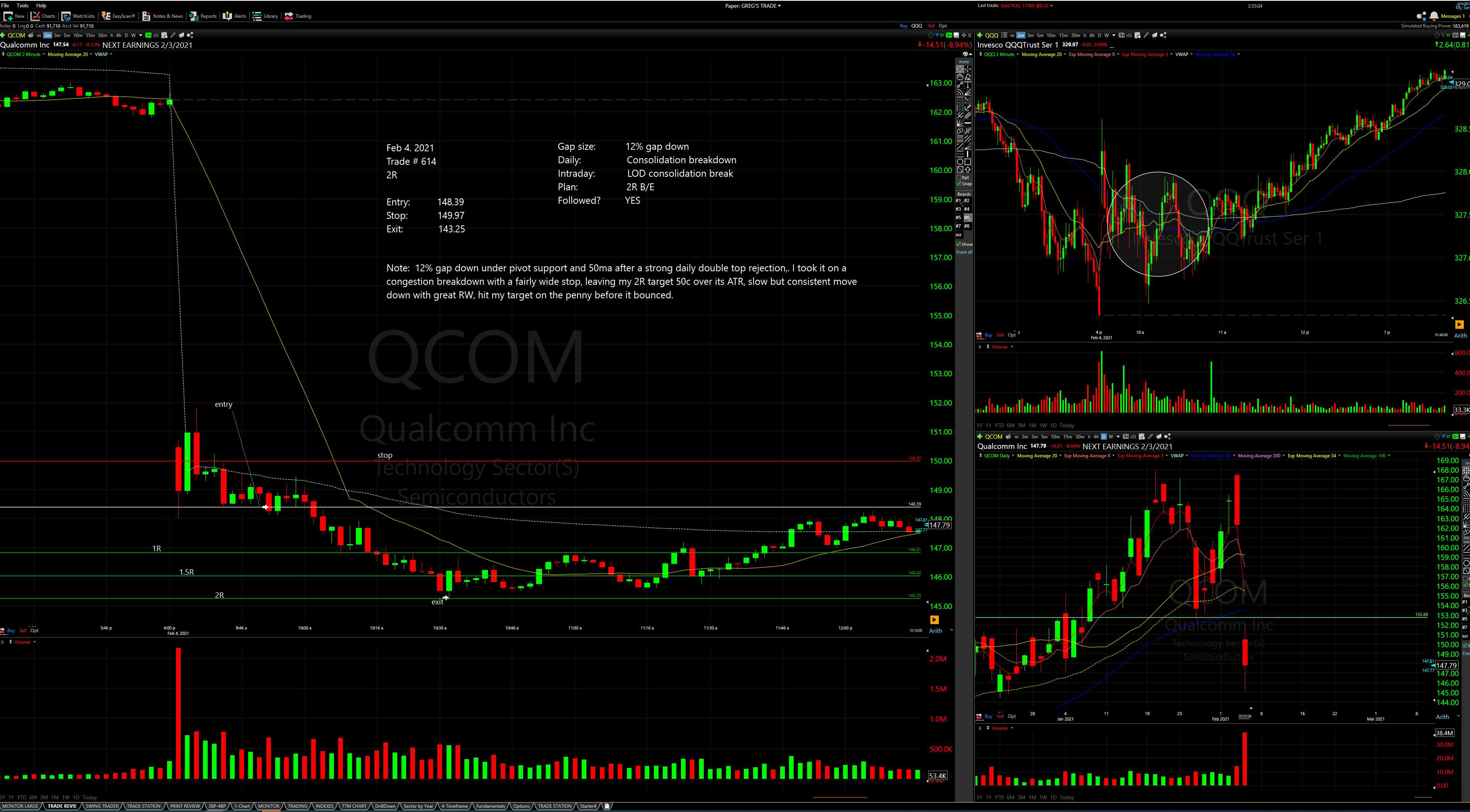
1st Trade QCOM +2R
148.39/149.97 exit 143.25
12% gap down under pivot support and 50ma after a strong daily double top rejection,. I took it on a congestion breakdown with a fairly wide stop, leaving my 2R target 50c over its ATR, slow but consistent move down with great RW, hit my target on the penny before it bounced.
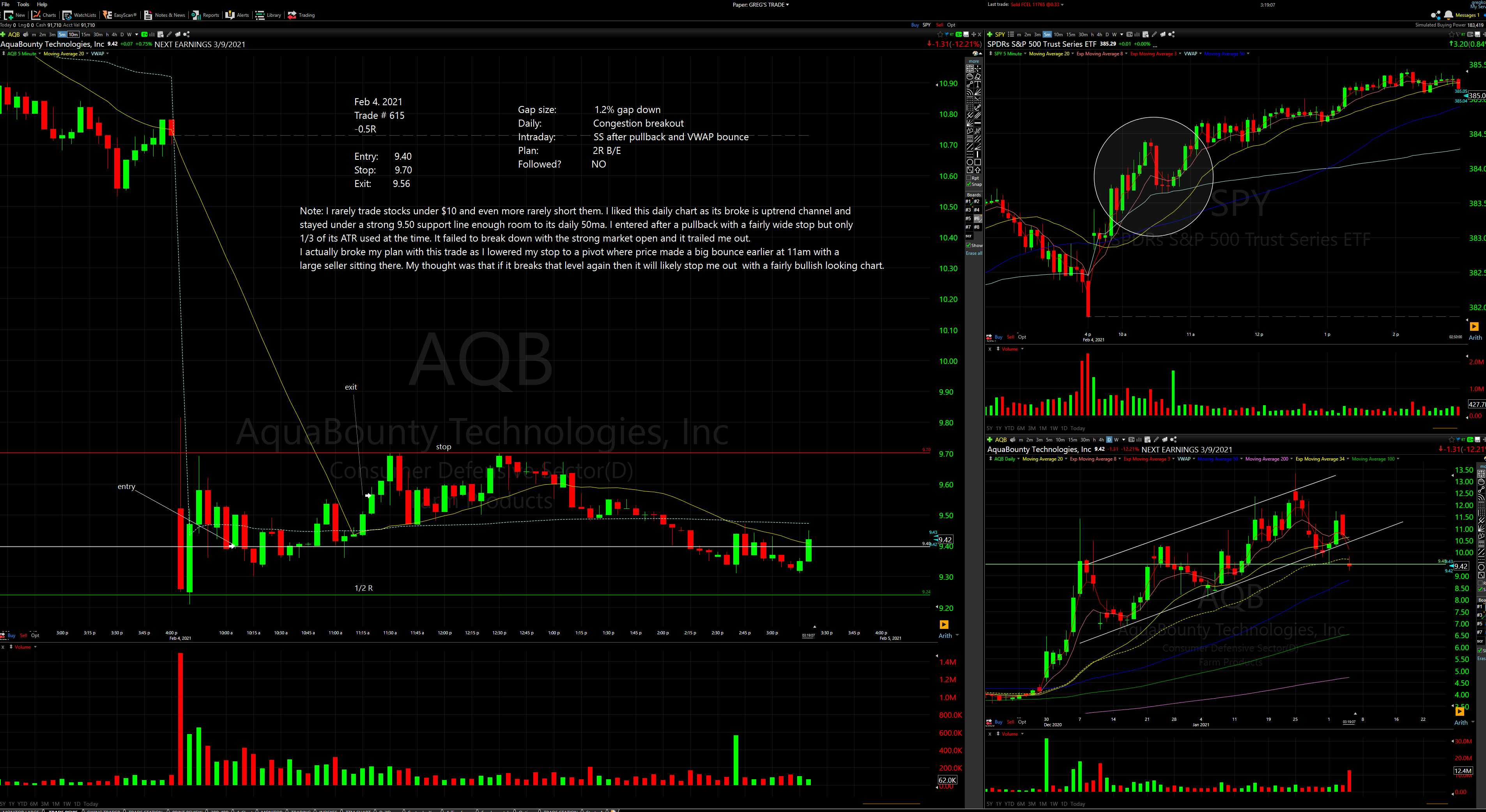
2nd Trade AQB -0.5R
9.40/9.70 exit 9.56
I rarely trade stocks under $10 and even more rarely short them. I liked this daily chart as it broke its uptrend channel and stayed under a strong 9.50 support line enough room to its daily 50ma. I entered after a pullback with a fairly wide stop but only 1/3 of its ATR used at the time. It failed to break down with the strong market open and stayed in a narrow range.
I actually broke my plan with this trade as I lowered my stop to a pivot where price made a big bounce earlier at 11am with a large seller sitting there. My thought was that if it breaks that level again then it will likely...
1 trade for (-1R)
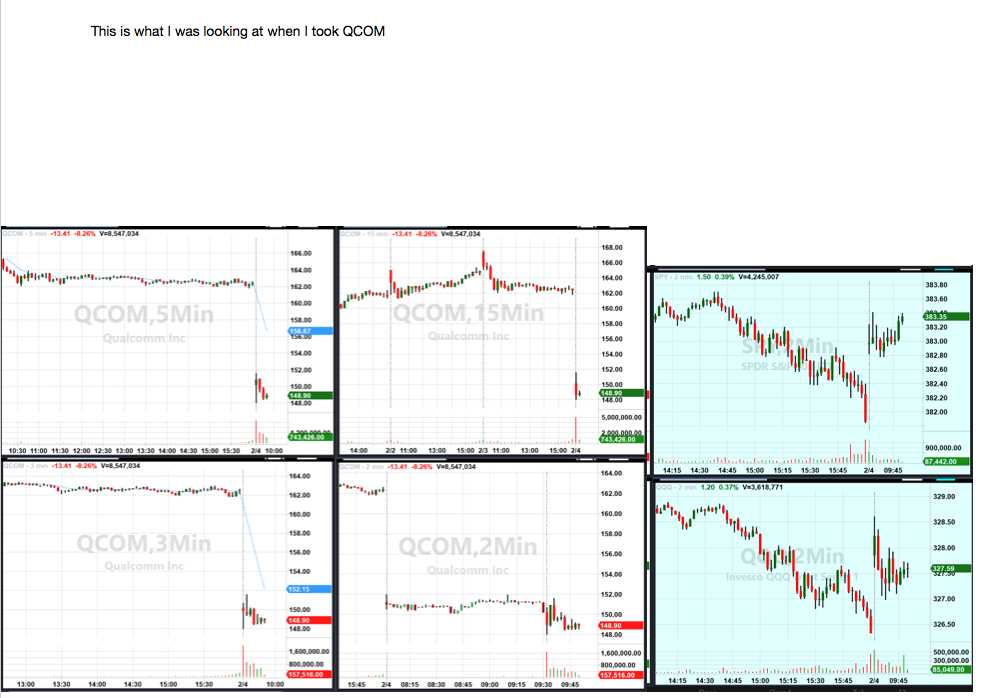
I took a BD on QCOM. I was worried about the target being close to the daily range, so I took a tighter stop on the 2 min chart. I am looking through PTS right now, most of the examples have 2 options for where to put your stop. It looks to me like one of the stops would be at the bottom of the main consolidation area, and the other at the bottom of where there has been a shakeout or turnaround bar (if there has been one). Due to the daily range I took the tighter one on this. In hindsight it seems obvious to take the wider stop, but in the moment it looked ok.
I was then looking at the 15 min 3BP on QCOM, but the reason I used a tighter stop in the first place was because of the range. The 15 min 3BP would have needed to have gone even further than the wider stop on the 2 min BD, so I didn't take it.